
Penetration Testing Framework
The purpose of this framework is to perform side-channel analysis (SCA) and fault injection (FI) attacks on the FPGA as well as on the chip.
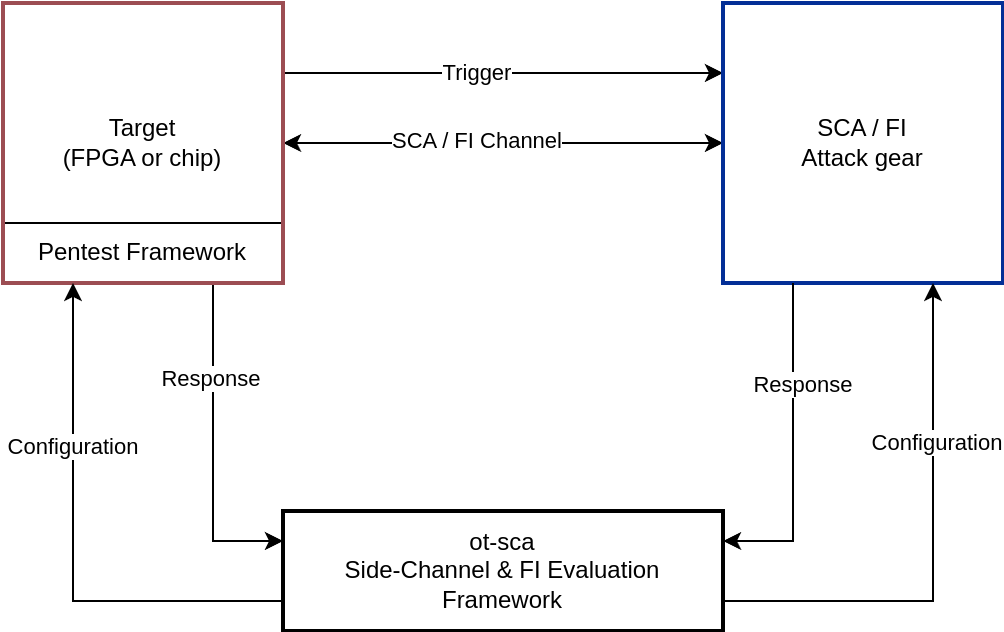
As shown in the block diagram, the pentest framework runs on the target and receives configuration commands by the SCA and FI framework.
Usage
To run the penetration tests either on the FPGA or the chip, please follow the instructions in the ot-sca repository. You can also find the files to communicate to the pentest framework via Python scripts in //sw/host/penetrationtests/python.
Contributing
When contributing to the pentest framework, run the automated testing as explained below.
Building Images
Due to code size memory limitations, the firmware for the chip and the FPGA is split into a SCA, general FI, IBEX FI, and ACC FI binary. To build these binaries for the chip, run:
cd $REPO_TOP
./bazelisk.sh build \
  --//signing:token=//signing/tokens:cloud_kms_sival \
  //sw/device/tests/penetrationtests/firmware:pen_test_sca_silicon_owner_sival_rom_ext

./bazelisk.sh build \
  --//signing:token=//signing/tokens:cloud_kms_sival \
  //sw/device/tests/penetrationtests/firmware:pen_test_fi_silicon_owner_sival_rom_ext

./bazelisk.sh build \
  --//signing:token=//signing/tokens:cloud_kms_sival \
  //sw/device/tests/penetrationtests/firmware:pen_test_fi_ibex_silicon_owner_sival_rom_ext

./bazelisk.sh build \
  --//signing:token=//signing/tokens:cloud_kms_sival \
  //sw/device/tests/penetrationtests/firmware:pen_test_fi_acc_silicon_owner_sival_rom_ext

./bazelisk.sh build \
  --//signing:token=//signing/tokens:cloud_kms_sival \
  //sw/device/tests/penetrationtests/firmware:pen_test_cryptolib_sym_fi_silicon_owner_sival_rom_ext

./bazelisk.sh build \
  --//signing:token=//signing/tokens:cloud_kms_sival \
  //sw/device/tests/penetrationtests/firmware:pen_test_cryptolib_asym_fi_silicon_owner_sival_rom_ext

./bazelisk.sh build \
  --//signing:token=//signing/tokens:cloud_kms_sival \
  //sw/device/tests/penetrationtests/firmware:pen_test_cryptolib_sym_sca_silicon_owner_sival_rom_ext

./bazelisk.sh build \
  --//signing:token=//signing/tokens:cloud_kms_sival \
  //sw/device/tests/penetrationtests/firmware:pen_test_cryptolib_asym_sca_silicon_owner_sival_rom_ext
The binaries are located in bazel-bin/sw/device/tests/penetrationtests/firmware/.
Automated Testing
To automatically test whether the pentest framework works, an automatic testing framework is provided. This framework compares the responses of the pentest frameworks with reference testvectors.
Use the following command to automatically test the Ibex FI tests on the CW340 FPGA board:
cd $REPO_TOP
./bazelisk.sh run //sw/device/tests/penetrationtests:fi_ibex_fpga_cw340_sival_rom_ext
In addition, we have Python scripts to use the pentest framework in //sw/host/penetrationtests/python.
These scripts are also tested.
Use the following command to automatically test the Ibex FI tests on the CW340 FPGA board:
cd $REPO_TOP
./bazelisk.sh run //sw/device/tests/penetrationtests:fi_ibex_python_test_fpga_cw340_sival_rom_ext
GDB Testing (FiSim)
The crypto library is tested on a debug enabled CW340 FPGA by tracing several relevant cryptographic calls and apply instruction skips or other fault models to their execution. In order to use this testing, the CW340 FPGA has to be adapted. We provide a picture on its setup as reference:
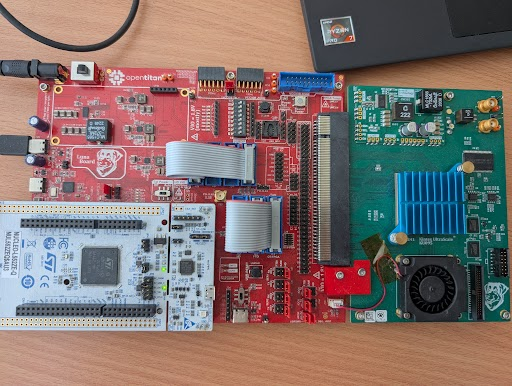
In order to run a GDB test, find the “gdb_test” targets in the BUILD file in //sw/device/tests/penetrationtests. For example,
./bazelisk.sh run //sw/device/tests/penetrationtests:fi_sym_cryptolib_python_gdb_test_fpga_cw340_rom_ext

./bazelisk.sh run //sw/device/tests/penetrationtests:fi_asym_cryptolib_python_gdb_test_fpga_cw340_rom_ext
These tests specifically run in the rom_ext environment since this is a ROM version in the RMA lifecycle which enables debug. The test then builds and runs openocd in the background which opens the default port 3333 to GDB. The files in //sw/host/penetrationtests/python/util contain classes in order to communicate with the FPGA, OpenOCD, and GDB.
The testing is performed on the flashed pentest framework in this directory which provides the interface to the crypto library in //sw/device/lib/crypto. The targeted functions are found parsing the dis file. The parser is also found in //sw/host/penetrationtests/python/util.
All test outputs are saved in the bazel-testlogs/sw/device/tests/penetrationtests folder. Take note that the output to the terminal is piped to the campaign file in that directory, please consult this file for the test output. This is done since each subtest can take 2-12h.
Secure Code Guidelines and Fault CI Tests
There are secure coding guidelines written in //sw/device/tests/penetrationtests/firmware/firmware_gdb.c. These contain examples on how to write secure code for the crypto library. These guidelines are also tested via fault simulation. In parallel, these tests serve as the CI tests of fault simulation tools to keep these tools updated and running since the regular tests can take several hours.
Versioning
In //sw/device/tests/penetrationtests/firmware/lib/pentest_lib.h, a value PENTEST_VERSION is found with the current version of the pentest framework.
The versioning has the syntax: vx.y.z (epoch.major.minor).
The version number signifies the release of the pentest framework.
- New releases providing minor changes such as patches, bugfixes, adapted functionality increase z.
- New releases providing major breaking changes increase y.
- x is kept for the epoch of the hardware.